
Election Observation Education: A New Course Guide for 2026
A new course guide for incorporating election monitoring as an experiential learning component.


Welcome to “Pericles in Practice,” our monthly Substack series exploring what community-engaged civic learning looks like on campuses and where it’s headed next.
What does democracy look like to students who have grown up during a pandemic, a constitutional crisis, and years of doubt about elections? For many freshmen entering college in 2026, these events are not distant history; they are the backdrop of their childhoods. Born in 2008, they were twelve when COVID-19 upended daily life, and thirteen when the U.S. Capitol was attacked on January 6. As they prepare to vote for the first time this fall, they carry with them an understanding of democracy shaped by turbulence, often filtered through social media.
Classroom learning is important. But there are some things about democracy you can only learn by showing up. I saw this firsthand in 2012, when my then-colleague Dr. Karen Kedrowski and I took students to a Presidential Nominating Convention as part of PLSC390: Presidential Nominating Conventions. One student put it better than I could:
“The main reason I took this class was to go to the ... National Convention. I did not really expect to do a great deal of learning. However, the knowledge snuck up on me. I not only learned about conventions, but I gained a vast amount of knowledge about politics in general. I understand voting systems and different parties and political groups, and most importantly, I figured out what it is I believe in. Going to the convention was a once in a lifetime opportunity, and I’m so glad I had the chance. I met so many people, and I will always remember 390.”
Some of that work happens closer to home. In 2020, with support from a Project Pericles Mini-Grant, I developed nonpartisan voter information materials and piloted them in two general education courses. The response was strong enough that the project has grown since then; the materials are now available across our university learning platform, targeted to general education courses, and published each year in a custom planner for incoming freshmen. For many first-time voters, it’s some of the first civic information they encounter in college.
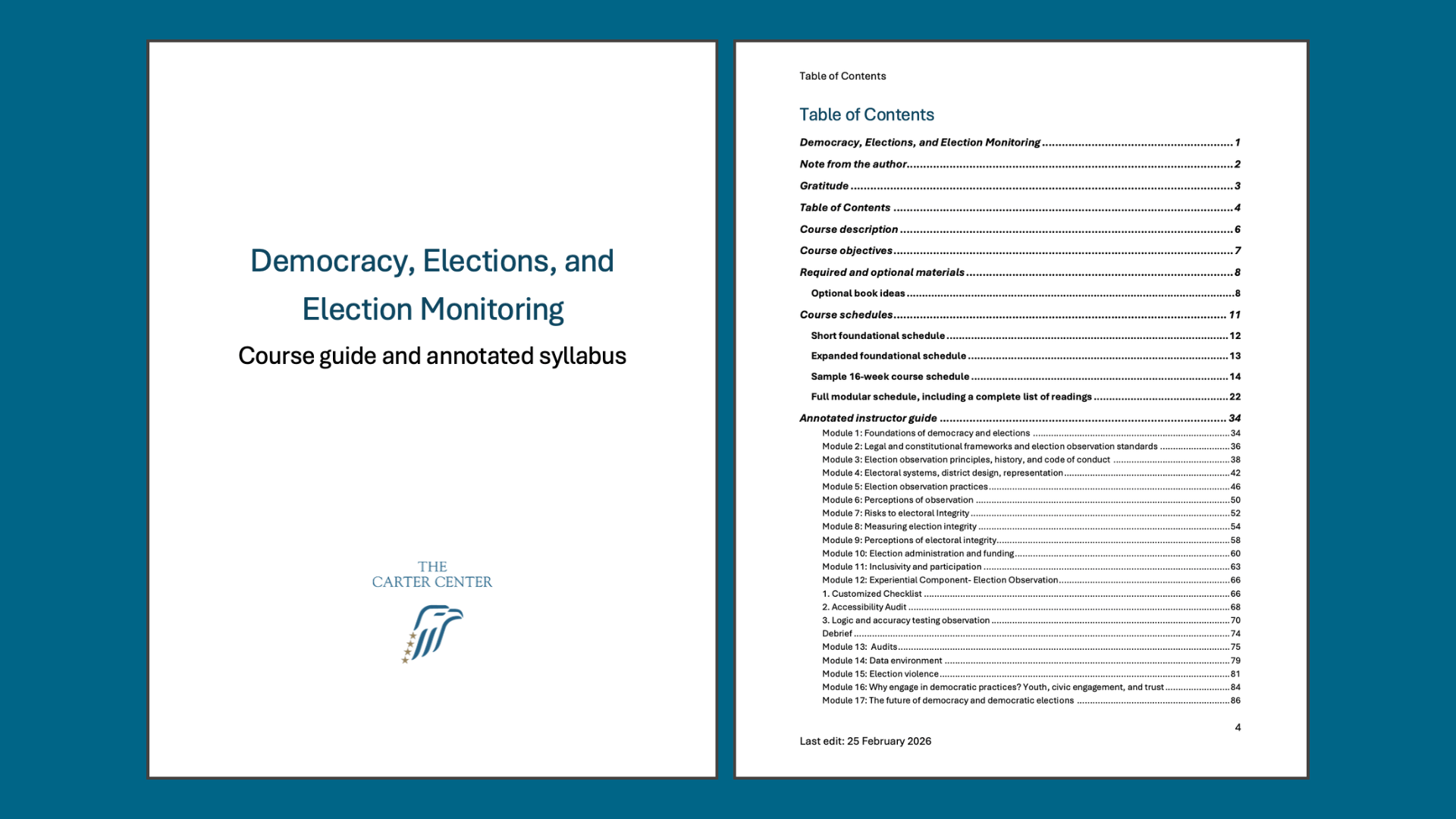
For the 2026 cycle, I have partnered with the Carter Center to release a course guide that offers instructors a framework for engaging students in the democratic process through local election observation. Election observation lets students examine how elections actually work in their own communities. Students learn how they are administered, who has access, and what the voter experience is like. It’s also a chance to build something we need right now: trust in democratic institutions.
Depending on a state’s laws, students could observe a polling place on election day or during early voting, using a structured checklist to understand how elections work in practice; conduct an accessibility audit to evaluate whether voters with disabilities have full and equal access; watch logic and accuracy testing of voting machines before an election; or attend provisional ballot hearings and observe poll worker training in states where direct polling place observation is not permitted.
The students walking into our classrooms this fall did not choose to come of age during a constitutional crisis, pandemic, and years of doubt about elections. But they are about to vote anyway. The least we can do is offer them something more than cynicism to carry into the voting booth.
Access the Carter Center Democracy, Elections, and Election Observation Course Guide by clicking the button below.
Note: A name and email address are required to access the guide.
Katarina Moyon’s education in campaigns and elections began at 13, interning for a state legislative candidate in Tempe, Arizona, whose tied election was ultimately decided by a hand of blackjack, rather than a runoff. She went on to build 20 years of expertise in higher education at Winthrop University, teaching courses in American government, international politics, presidential nominating systems, and careers in political science, while co-leading the university’s award-winning civic and voter engagement program.
Today, Katarina runs Deep Dive Research, serving clients who share her passion for informed, engaged citizenship. She specializes in nonpartisan civic education, voter engagement, and social science research. She earned an M.A. in International Affairs from George Washington University and a B.A. in International Affairs and German from Northern Arizona University.
Help Project Pericles keep work like this thriving. Donate today to support the next wave of civic learning and action.
 | A guest post by
|