
Pericles as Founding Father: Democracy from Athens to America
Reflections for Project Pericles' 25th anniversary

To mark our 25th anniversary, we invited Joanna Kenty–classics scholar, civic educator, and contributor to Danielle Allen’s The Renovator–to explore the legacy of Pericles in his full complexity and in direct conversation with the democratic challenges of our present moment. The result is a two-part essay series that brings rigorous classical scholarship to bear on questions that feel anything but ancient: What does it mean to inherit a democracy? Who gets to belong? What happens when democratic ideals and democratic practice diverge?
This first essay, “Pericles as Founding Father: Democracy from Athens to America,” is published below. A second essay is forthcoming. Together they offer a reading of Periclean Athens that is neither nostalgic nor dismissive. We hope they can be instructive for anyone trying to understand, and sustain, democratic life in 2026.
“I will begin first with our ancestors, for it is right and fitting that we honor their memory on this occasion. They dwelt continuously in this land, generation after generation, and by virtue of their excellence handed it down a free one still today.”
(Pericles’ Funeral Oration in Thucydides’ History of the Peloponnesian War, 2.36)
We’re surrounded these days by reminders that it’s America’s 250th birthday: it’s been 250 years since 13 colonies declared independence from Britain and decided that instead of instituting a new monarchy, they’d empower their people to govern themselves instead.
Appropriately enough, it’s also Project Pericles’ 25th birthday. Why appropriately? The obvious reason is that Project Pericles has been supporting civic learning and democratic principles since its inception, building the kind of civic culture that the founders of the United States had in mind.
But it’s also appropriate because Pericles (pronounced “PEH-ri-klees” in English) himself represented the golden age of popular government in the ancient Greek city-state of Athens, its height of power and prosperity, accomplished under democratic systems (krateia, rule, by the dêmos, people). And Athenian democracy was an important reference point or model for American lawmakers as they worked to design a constitution that would allow the United States to reach the same heights of cultural brilliance and shared material prosperity.
In 2026, as we ourselves confront an era of democratic backsliding and a historically low level of faith in democracy around the globe, the Athenian democracy of Pericles’ lifetime offers us powerful lessons, not only in its glory days but in its chaotic and destructive decline.
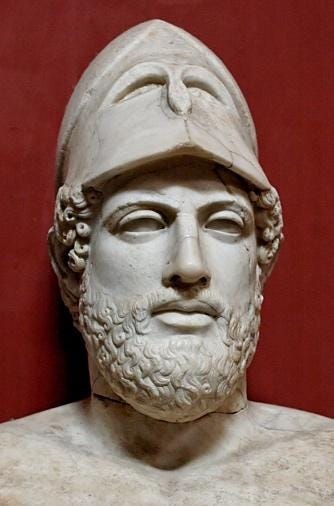
If he had been born into an aristocracy (rule, or krateia, by society’s aristoi, the best) or a monarchy (rule, or archê, by monos, one), Pericles would have enjoyed the life of a nobleman on the basis of a long and distinguished pedigree. But Pericles was born in a democracy, where the people ruled. His own ancestor, Cleisthenes, was one of the founding fathers of democracy in Athens.
According to Aristotle (or one of his students), Cleisthenes and the philosopher Solon created the democratic constitutions of Athens – its founding fathers, if you will. Solon refused to take sides in the uprisings of the exploited poor against the exploiting rich, and acted as a shield to both while pleasing neither, according to his own poems on the subject. He and Cleisthenes enacted systems of sortition – choosing council members and some magistrates by lottery rather than voting – which allowed common citizens of no particular distinction to play roles as legislators, administrators, jurors, and participants in political decisions. All citizens (all male) were equal in the eyes of the law, and anyone could go to court to defend his own property or his rights.
In addition to his wealth and impressive family name, Pericles was also one of the great political minds and orators of his day, and used his rhetorical skills (as well as a lot of complicated maneuvering against his rivals) to win the adoration of the Athenian people. He was elected by the people to be one of the generals (stratêgoi) commanding Athenian soldiers and ships, for many years consecutively. Thucydides, the Athenian historian who chronicled Pericles’ career in his history of the Peloponnesian War only a few decades after the events, calls Pericles “the leading Athenian at that time and a man of the greatest ability both with words and in action,” a description that evokes the heroes of the Iliad. “His power was in his distinguished reputation and his intellect, and he was patently incorruptible,” Thucydides reports.
It is thanks to Thucydides that we have some version of Pericles’ most famous speech: the Funeral Oration Pericles delivered in 431/430 BCE (the Greek year doesn’t correspond to ours) to honor the men who died in the first year of the Peloponnesian War between the Greek city-states Athens and Sparta. Like all ancient historians, Thucydides used his own knowledge of rhetoric as well as historical events to reconstruct important speeches in history, reshaping them to fit into his historical narrative.
In the Funeral Oration, Pericles opens rather dubiously by talking about how hard it is to deliver a eulogy that will actually satisfy a grieving audience. In fact, he says, instead of talking about the men who died, it’s really more appropriate to talk about what they died for: their country. They dedicated their lives to Athens. Why? What was so great about Athenian society? Pericles emphasizes democracy, so named “because it is administered on behalf of the many and not the few” (Johanna Hanink’s translation). In Athens’ unique constitution which “set[s] the example” for others, he says, “Everyone enjoys equality before the law on matters of civil disputes.” Equality before the law, isonomia, was a crucial precondition for democracy that prevented the few from tyrannizing over the many, as they had before the days of Solon. Equality of opportunity was also crucial, allowing anyone of merit to advance:
“As to personal reputation, whoever wins esteem for some reason can advance in public affairs— not by turn, but through merit. And as to poverty, no one who is able to perform a good service for the city is prevented by his humble station from doing so.” (Johanna Hanink’s translation)
Every citizen, no matter the conditions into which he had been born, was able to fulfill his potential – not to benefit himself and his family, as we individualistic Americans might expect Pericles to say, but to perform a good service for Athens. Pericles lived long before Enlightenment philosophers would popularize ideas about individual rights and liberties, and the civic virtue he celebrates has more to do with service to the collective, even self-sacrifice, than individual freedom.
In Athens, every citizen had his civic duty, his responsibility to serve, according to his means.
“Those who manage our civic life are equally attentive to their private affairs while those wrapped up in their own pursuits are also well-informed about politics. We are the only ones who do not see lack of public participation as minding your own business: we regard such non-participants as useless.” (Johanna Hanink’s translation)
Athenian citizens served in government and in the military; wealthier citizens contributed money to build ships and public infrastructure. Citizens worshipped together, watched drama and poetry performances together, and considered public issues together, each contributing their own opinions and considerations to form a thorough discussion. As Pericles claims, “We also take care to decide – or at least carefully deliberate on – public matters for ourselves, for we do not see discussion as an impediment to action but think it worse to act precipitously without the benefit of first informing ourselves by prior debate.” As a result, Athenians also prospered together. This, Pericles thought, translated directly into the power and prosperity of the city, and made it the kind of city that could command its citizens’ loyalty even to the death. In his view, Athenian soldiers had died for the worthy cause of preserving the freedom that their ancestors had received from Solon and Cleisthenes, and handed down through the generations as a legacy.
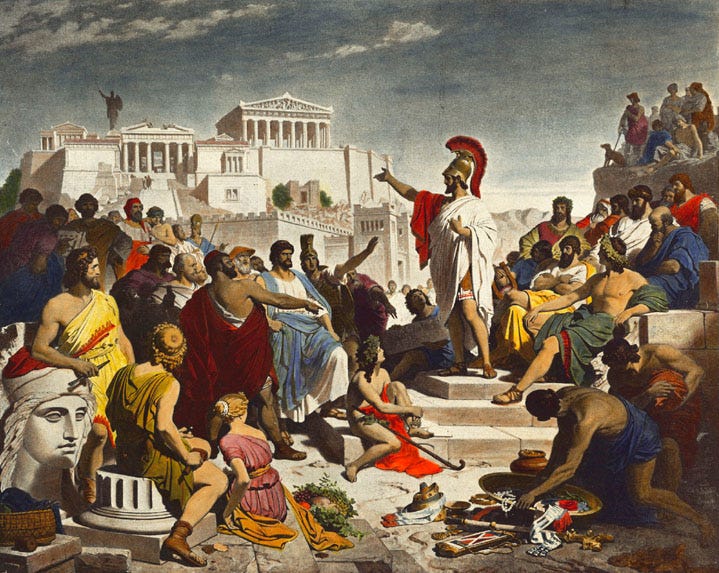
In thinking about Pericles in relation to America’s founding fathers in this semiquincentennial year, I think about Pericles as the Athenian answer to George Washington: not a lawgiver but a military commander with remarkable presence and dignity, known for his integrity and responsible use of power, whose time as a leading citizen in a democratic society was later viewed with nostalgia as the time when the system was working the way it should. Like Washington, he was known for his leadership despite leading through more defeats and setbacks than victories. And like George Washington, Pericles (through Thucydides) even issues a sort of parting warning about dangers to his country from within and without before his death, when all those dangers become all too real.
Pericles’ Funeral Oration idealizes Athens and lifts it up as a model, but if you continue on reading Thucydides, you start to think that this wasn’t so much the beginning of a golden age but the end of one, and Pericles just didn’t know it yet. This was the first of many years of the Peloponnesian War, which dragged on and on, bleeding Athens’ resources dry. As Athens levied harsher taxes on its allies to pay for the war, those allies revolted, and Athens was brutal in quelling those revolts. Their cruelty in lecturing one of those allies that “the strong do what they can, while the weak suffer what they must” has been glossed approvingly by some leaders, but reads in Thucydides as an indictment of even a “democratic” imperialist power’s casual disregard for others’ humanity.
In 429 BCE, to make matters worse, a plague devastated Athens and completely ruptured civil society. Pericles was one of many who lost his life to the epidemic (another use of the root word dêmos). In the power vacuum after his death, irresponsible and manipulative demagogues rose to power and steered Athens toward increasingly disastrous decisions.
For Thucydides and Plato, as well as later readers like James Madison and Alexander Hamilton, Athenian democracy proved to be too volatile, too radical, too susceptible to manipulation and its own irrational worst impulses. In fact, as Thucydides comes to write Pericles’ obituary, he contradicts Pericles’ own characterization of Athenian democracy in the Funeral Oration (which, let’s recall, Thucydides wrote):
[Pericles] controlled the mass of people with a free hand, leading them rather than letting them lead him. He had no need to seek improper means of influence by telling them what they wanted to hear: he already had the influence of his standing, and was even prepared to anger them by speaking against their mood. For example, whenever he saw them dangerously over-confident, he would make a speech which shocked them into a state of apprehension, and likewise he could return them from irrational fear to confidence. What was happening was democracy in name, but in fact the domination of the leading man. (Martin Hammond’s translation)
So where is the line between popular democratic leader and autocrat?
And why did Thucydides include the Funeral Oration at all, with its glorification of Athens, if he thought Athens and its democracy proved to be far from glorious? Maybe because, like us on America’s 250th birthday, he still wanted to look back to the promise of democracy, briefly if ever realized, as a beacon of hope for the future. Pericles wasn’t a perfect leader, but he was a great one. He was committed to serving his city, and to serving the interests of the many rather than the few. He used the power of persuasion to lead, even when he had to challenge prevailing popular opinion or groupthink. Thucydides had seen the Athenians choose less effective and less ethical leaders after the death of Pericles, but perhaps he hoped they could choose better ones in the future.
Just as Pericles wasn’t a perfect leader, Athens wasn’t a perfect democracy. Athenian society was far from equal or free, by the numbers. Athenians treated their allies and enslaved people pretty appallingly and excluded women from self-determination entirely. But they prized free speech, equality under the law, and civic participation, cornerstones of democracy today. And their use of direct democratic procedures like sortition is starting to appeal to today’s political thinkers and organizers as a way to make further progress in realizing the founders’ ideals of equality and self-determination.
As Project Pericles enters its next quarter century, we’re guided by these lessons from Pericles, both the good and the bad, the aspirational and the abhorrent, in approaching the hard work of democracy. The glory of the Funeral Oration – and of democracy itself – is fragile and ephemeral. It doesn’t maintain itself. It depends on a delicate balance of leadership and mass civic responsibility by citizens who are never perfect. “More perfect” is as good as it gets – but that can be pretty great.
If you’re interested in reading more on this subject, stay tuned for our second installment! But you might also check out:
How to Think about War: An Ancient Guide to Foreign Policy by Thucydides, Edited and translated by Johanna Hanink
Pericles: Statesman, Demagogue, Eccentric, upcoming book from Paul Cartledge
Mass and Elite in Democratic Athens: Rhetoric, Ideology, and the Power of the People by Josiah Ober (or his many other excellent books)
 | A guest post by
|