
Residential Learning and the Surprising Power of Showing Up
Students from Wake Forest University's Hopkins Hall build empathetic relationships with adults living with dementia through a First-Year Seminar, using the arts and poetry.


On a Wednesday evening in late April 2026, six students gathered in the parlor of Hopkins Hall, tired, a week from finals, eating pizza and writing poems. Their poems responded to Annie Lighthart’s “A Cure Against Poisonous Thought,” about what they had noticed, felt, and carried with them during a semester of working alongside adults living with dementia at the Intergenerational Center for Arts and Wellness in Winston-Salem. Every single one of them said some version of the same thing before leaving: we should do this more often. We would come back.
That small and unhurried moment is one I’ll cherish.
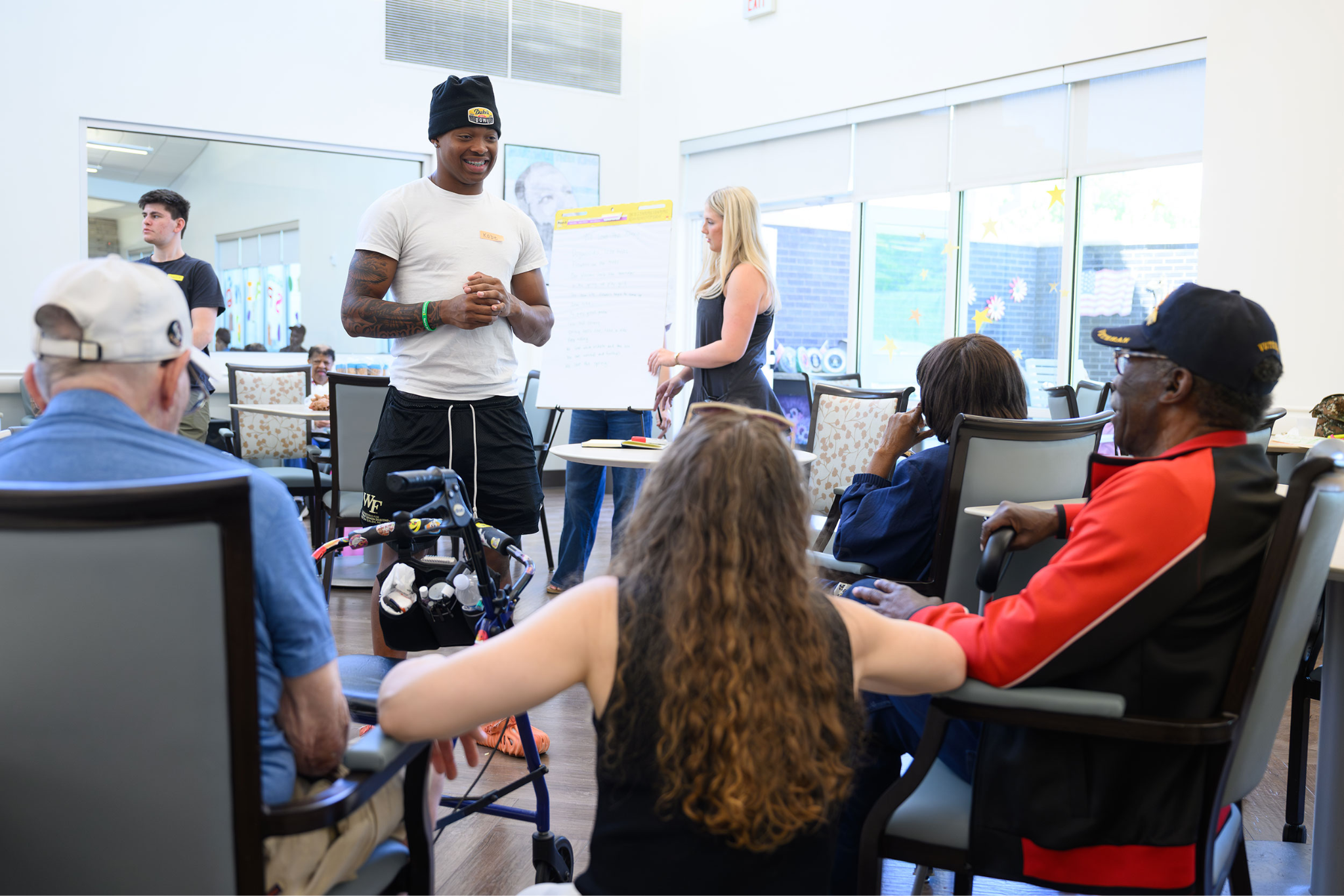
This year, with support from Project Pericles’ Mini-Grant program, I designed and taught FYS 100 Creative Care: Empathy and the Benefits of Community Engagement, a First-Year Seminar (FYS) that asked students to do something seemingly simple: show up for someone other than themselves and pay attention to what that costs and what it gives. The course was embedded in a larger residential civic engagement pilot, the Office of Civic & Community Engagement (OCCE) x The Forest partnership, housed in Hopkins Hall, one of Wake Forest’s first-year residential commons.
My question was straightforward but ambitious: What happens when you build civic engagement into the very fabric of where students sleep, eat, and become themselves?
The grant support made it possible to develop curriculum, deepen our community partnership with the Intergenerational Center, and create programming that connected classroom learning to everyday experience, including the narrative medicine workshop I offered at the end of the year. The Williams Adult Day Center, which operates within the Intergenerational Center, became the anchor of my course. Students didn’t just read about dementia and its effects on low-income families; they built meaningful relationships with real people, and they came back to campus changed.
The numbers bear this out in ways that surprised even me. Ninety-nine percent of students enrolled in my FYS sections this year reported that they were likely or very likely to continue volunteering. Pre-survey data from an IRB-approved study co-led with Senior Faculty Fellow Brian Calhoun showed statistically significant differences between Hopkins residents and their peers in another hall: Hopkins students entered the year already believing more strongly that individuals can make a difference in their communities (4.69 vs. 3.80 on a 5-point scale, p = .008, large effect), and after one month, 45% reported increased civic commitment, compared to 0% in the comparison group. These are promising early indicators that the residential model is working, though we are appropriately cautious about causal claims while we await our April post-survey data.
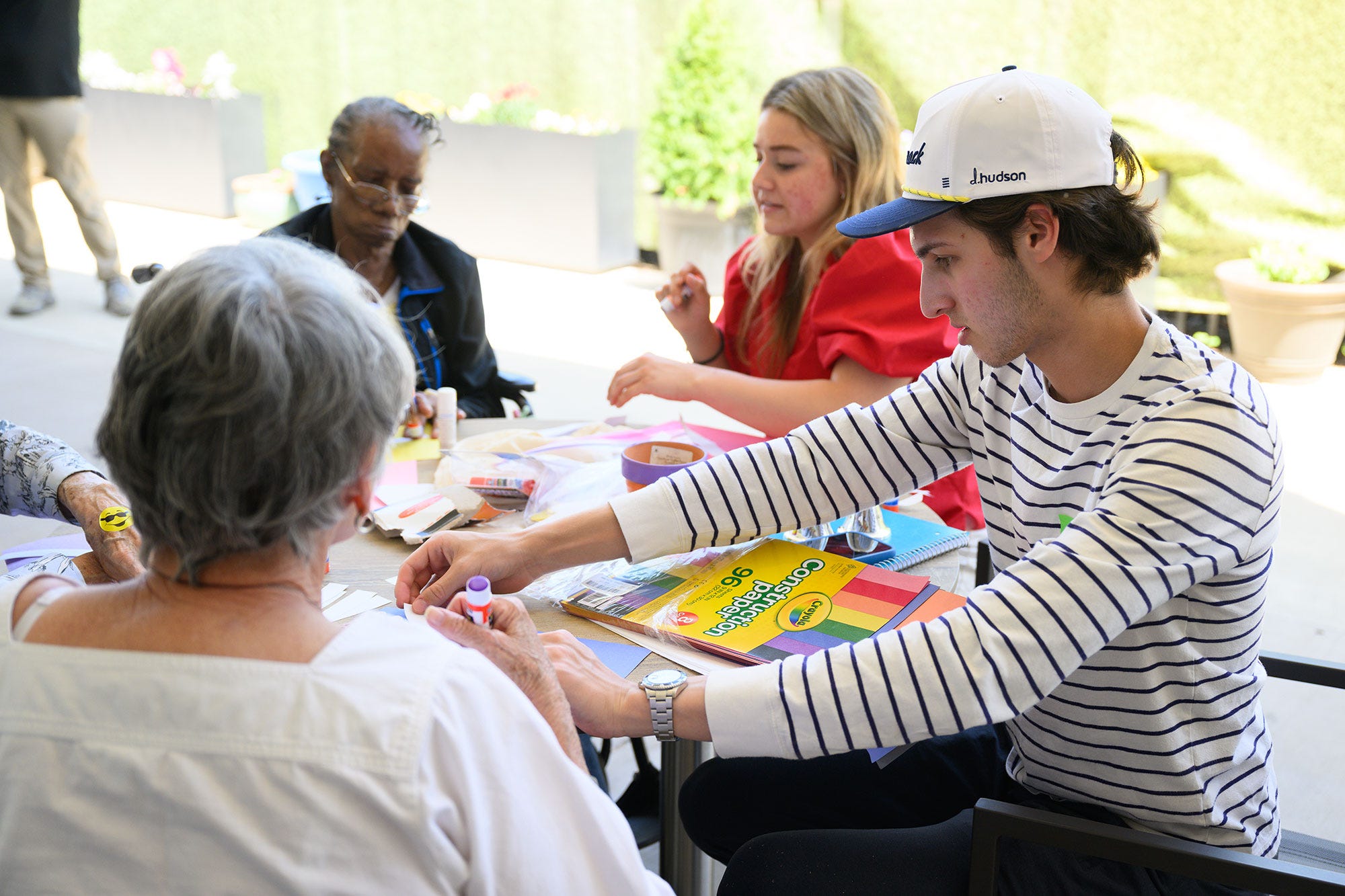
What I did not anticipate was how much the students would teach me. One student in my spring course, one of those who joined me for Pizza and a Poem outside of class, designed her own Empathy Adventure, a 24-hour challenge to navigate daily life using only her non-dominant arm, as a way of building embodied understanding of what it means to live with a physical disability. The assignment was so thoughtfully conceived that I adopted it for the whole class. Her peers described it as one of the most humbling experiences of the semester. Another student wrote an essay about Harold, a resident at the Williams Center who introduced himself as a troublemaker and told her about his football days over and over, each time as if for the first time, that moved me in the way good writing does: it held complexity without resolving it into something tidier than the truth.
For faculty considering this kind of work, my advice is this: resist the urge to over-engineer it. Yes, community-engaged learning requires infrastructure, IRB protocols, community partnerships, and assessment tools, but its most powerful moments tend to be unplanned. They happen when a student lingers after a visit, when a community member chooses to trust you with something real, when six tired people eat pizza together at the end of a hard semester and find, to their own surprise, that they feel better when they are together. Your job is to create the conditions for those moments and then get out of the way.
I am also deeply grateful that the Intergenerational Center for Arts and Wellness, the community partner at the heart of this work, was recognized this year as Community Partner of the Year by NC Campus Engagement, a statewide consortium of 39 colleges and universities. Housed in the Intergenerational Center, the Elizabeth and Tab Williams Adult Day Center, where my FYS students volunteered this academic year, welcomed our students with patience and generosity, and they made this work possible in the truest sense. Students told me they believe this model—pairing a residence hall with a specific community issue and a sustained community partner—should be expanded to other halls across campus. I think they’re right.
This grant helped me become a more intentional practitioner. It reminded me that civic engagement is not a program. It is a practice, one that requires continuity, humility, and willingness to be changed by the people you work with.
Help Project Pericles keep work like this thriving. Donate today to support the next wave of civic learning and action.
 | A guest post by
|